


You Did the Yardage. Did You Get Better?
Six thousand yards is not the same as improvement. The four questions that turn a practice into a building block.
Think about your last practice.
Not how hard it was. Not how you felt at the end. What specifically got better?
Most swimmers cannot answer that, and it is not because they are lazy. You showed up. You did the sets. You were wrecked afterwards. But the whole thing was a blur, and a blur does not stack. You can put ninety blurs on top of each other between now and March and arrive exactly where you started, wondering why the work did not show up.
September is the build. Nothing you do this month drops time this month. Everything you do this month decides what you have available to you in March.
So it is worth knowing the two traps, because almost every swimmer falls into at least one of them.
Trap one: trying to fix everything
You already know your weaknesses. You probably have a list. Your turns, your back half, your breathing pattern, your starts, the thing your coach mentioned on Tuesday.
So you walk on deck and try to fix all of it.
What actually happens is you put a little attention on your turns for two reps, then you forget about it, then you think about your breathing for a set, then that goes too. You never actually develop any of it. You worked hard and got nothing on board.
Here is lesson number one, and it is not really about swimming:
When you are focused on everything, you are technically focused on nothing.
We are human beings. We can genuinely only get better at one thing at a time. That is not a weakness in you, it is just how attention works — and once you know it, you can use it.
So before you get in: pick one thing.
Today I am going to focus on ___. One capability. I do not care what it is — you pick. Your breakout off the wall, holding your stroke count when you are tired, your kick timing on the third 50. One.
Pick it before you get on deck, while you are calm. Ask yourself honestly: are you better at making decisions standing on the pool deck at warm-up, or gassed in the middle of the hardest set of the week? Decide early, and when it gets hard you are not inventing something new under pressure. You are going back to the thing you already chose.
Trap two: what you do after
This one has two versions, and both are common.
Version one: you do not look back at all. Practice ends, you get in the car, you are on your phone, it is gone. Whatever happened in there — good and bad — leaves with you. Nothing gets learned, so nothing carries into tomorrow.
Version two: you look back at only the bad. You replay the set you died on, the turn you blew, the thing your coach said. This is the more common one by a distance, and if this is you, you already know it, because that stuff lives in your head for hours afterwards.
The fix for both is the same thing, and we call it the decompression.
The decompression: three, one, one
After practice — properly after, not three days later — you answer three questions.
1. What are three things that went really well today?
Three. And I do not care how bad the practice was, there are three. This is the part everybody wants to skip, and it is the part that matters most.
They have to be capabilities you executed, not outcomes. Not “I had a good practice.” Not “my times were decent.” Something you did: my breathing pattern held through the back half of the endurance set. My push-off was tight on every turn in the main set. I stayed long on the first 25 of every rep.
2. What is one thing that did not go so well?
One. Not three, not five. One specific thing you can actually aim at tomorrow.
3. What am I going to do to fix it?
An actual action. This is the difference between reflection that builds something and reflection that just makes you feel worse.
Write it down. Photograph it. Send it to your coach.
Lesson number two
You find what you are looking for.
If you go looking for everything that went wrong, you will find it. It is always there, in every practice, for every swimmer who has ever lived. That is not honesty — it is just a search term. Look for garbage and you will come home with garbage, every single day, and it will feel like evidence.
Look for the capabilities you executed and you will find those instead. They were also always there. You just were not looking.
And here is why this matters far more than feeling better about your practice:
You race fast by being great at what you are already great at.
Race day is not where you build things. Race day is where you use what you already have. But you cannot use what you do not know you have — and if the only list you have ever made about yourself is a list of what is broken, you get on the blocks with no idea what your actual weapons are.
That is your job as an athlete. Not just to get better. To know what you are good at, specifically enough to reach for it when it counts. The three good things are how you build that list, one practice at a time, all season.
Putting it together
That is the whole protocol, and it is two decisions a day:
Before — one capability, chosen while you are calm, so you actually develop it instead of scattering. After — three capabilities you executed, one thing that did not go well, and what you will do about it tomorrow.
Same idea at both ends: one thing. It keeps you out of trap one going in, and out of trap two coming out.
This is not a Utah Swimming thing or a beginner thing. It is the same process the pros I work with run — the MLB guys included — every day they train.
Ninety practices that each moved one thing, or ninety practices that each went by.
Trained, not born. This is what the training part actually looks like.
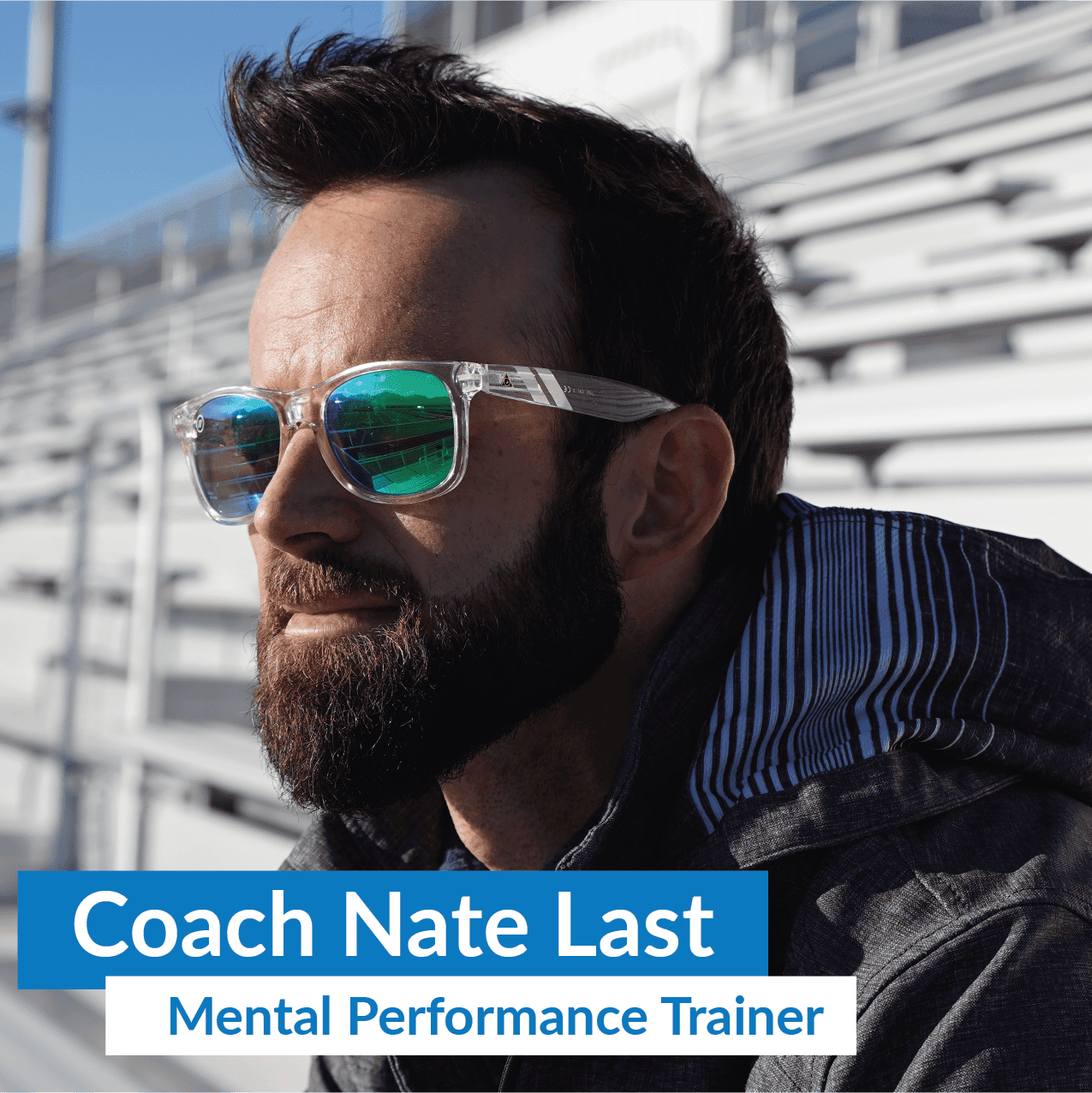
Nate Last — Mental Performance Coach
Nate is Utah Swimming’s Official Mental Performance Partner. He works with age-group and elite athletes on the part of the sport nobody schedules — confidence, composure, focus, and what happens in your head behind the blocks. Everything here is free to Utah Swimming families and coaches.

One mental-performance tool for athletes, parents, and coaches — every month in the Utah Swimming newsletter.
Mental Grit provides mental performance training, not mental health care. When a need is clinical, we connect families with licensed professionals.
Mental Grit Consulting is an independent organization and the official mental performance partner of Utah Swimming.