

More Self-Regulating Athletes. Zero Additions to Your Plate.
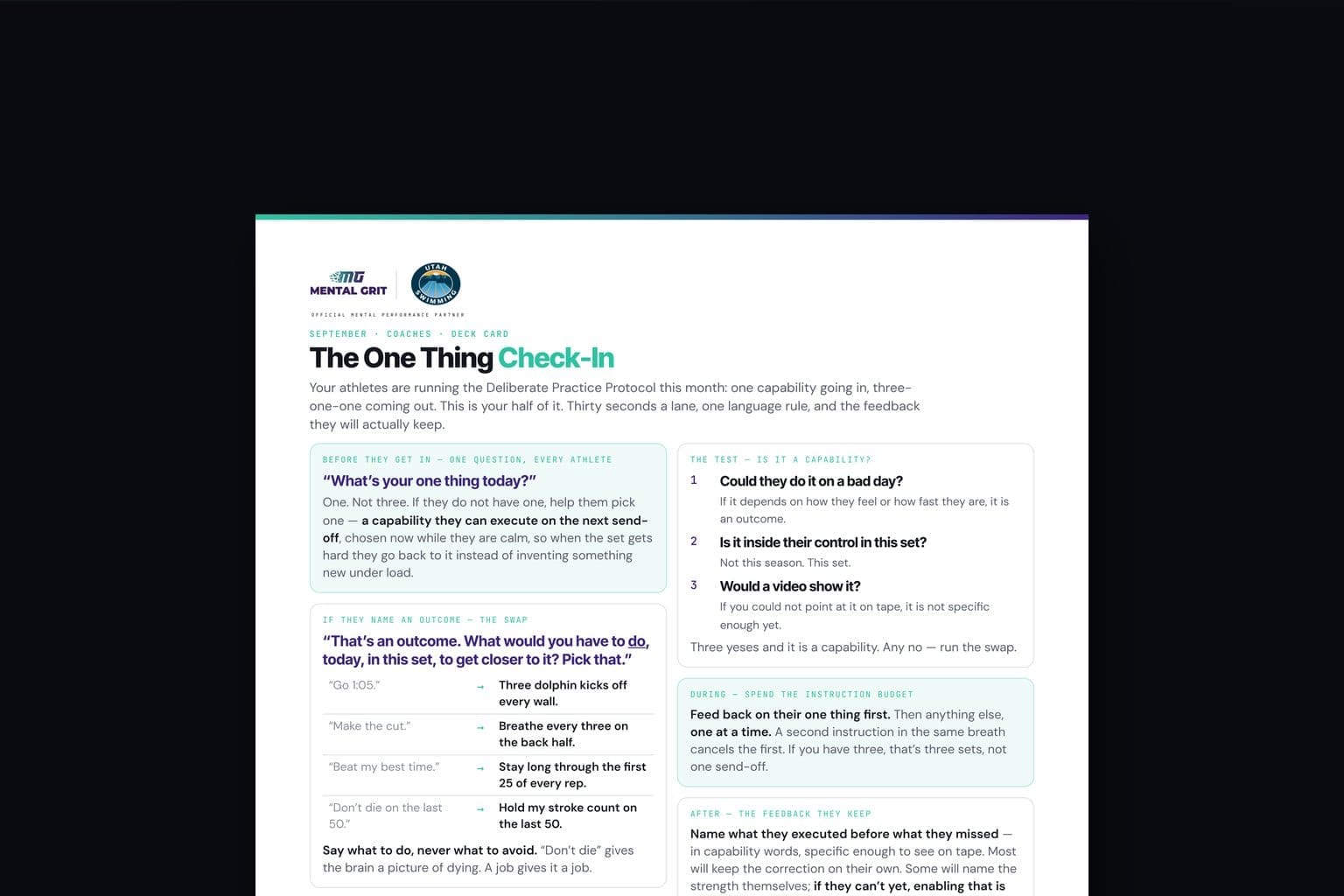
Book your team's workshops, and one tool a month written for your deck.
Two Free Virtual Workshops for Your Team
One Thing at a Time
Five corrections in one set land as zero, and the ride home replays only the bad. How a teenage athlete's attention actually works, and the one language change that fixes both.
Everything You Can Take With You
1 things to keep. This is the part that compounds.
What’s Showing Up on Your Deck?
Ask it. Coach to coach — I read every one and I answer every one personally.
This stays between us. Your question comes to me and my answer goes back to you. It is not posted anywhere and no other club sees it.
The Things People Ask
Is this therapy? What is the difference between mental performance training and seeing a psychologist or psychiatrist?
They are different jobs, and the line is bright.
Mental performance training is applied education in the arena. It teaches skills — attention, self-talk, emotional regulation, preparation routines — to people who are functioning well and want to perform closer to their capability. And it is applied: it happens where the sport happens, on deck and in practice and in the twenty minutes after a race, not in a room away from it.
There is a philosophy underneath that which is worth saying plainly. We are not here to fix problems. We are here to optimise potential. In the vast majority of cases an athlete does not have a disorder — they have simply never been taught how to use their mental capabilities to help them perform. That is a gap in their training, not something wrong with them.
Therapy and psychiatry are clinical care. They treat mental health conditions, they are delivered by licensed professionals, and they are about health rather than performance.
The two are compatible. Plenty of athletes do both, and one does not replace the other.
What matters is what happens when something crosses the line. If an athlete needs more than performance training, we say so directly and connect the family with licensed professionals rather than working around it. We do not diagnose, we do not treat, and we do not take the place of clinical care.
Who is Coach Last?
Nate Last is the founder of Mental Grit and Utah Swimming's Official Mental Performance Partner.
He holds an M.S. in Performance Psychology and an MBA from the University of Utah, is a co-author of the Amazon bestseller Deliberate Discomfort, and previously served as Chief Engagement Officer at Mission Six Zero, working on high-performance leadership. He played collegiate lacrosse at the University of Utah and has completed three Ironman triathlons and sixteen half-Ironmans.
Over the last decade he has worked with hundreds of teams and thousands of athletes, parents and coaches.
The reason he does this is more useful than the résumé: he quit sports as a young athlete — not because his body gave out, but because his mental game did and nobody was coaching it. He found performance psychology in his collegiate years and decided to become the person he needed as a teenager.
Who is Coach Lauren Poole?
Lauren Poole coaches with Mental Grit, and when it comes to swimming specifically she has lived every inch of it.
Four years swimming at the University of Kentucky — team captain and school record holder, SEC champion, six-time All-American, and a two-time Olympic Trials qualifier (2016 and 2020).
She holds an M.S. in Sport & Exercise Psychology from Kentucky, is a Certified Mental Performance Consultant (CMPC), and has worked in the Mental Training Lab at the US Military Academy at West Point.
She also swam through shoulder injuries, time out of the water and the rehab afterwards, with a sport psychologist in her corner throughout. She coaches the thing she needed, for the sport she came from.
How is this different from traditional sport psychology?
First, a note on titles, because the distinction is real and worth being precise about.
Coach Poole and I are sport psychology consultants, not sport psychologists. A sport psychologist is a licensed psychologist who specialises in sport and can provide clinical care. A consultant is trained in the performance side and works on skills — Lauren holds the CMPC (Certified Mental Performance Consultant) credential, which is the certification for exactly this work. The difference is one of scope, and it is why we refer rather than treat.
On the work itself: traditional sport psychology is often reactive and clinical in shape — an athlete has a problem, they are referred, they meet a practitioner, and the work happens away from the sport.
What we do is proactive and built like coaching.
- It is skill-based, not problem-based. You do not need something to be wrong to train your attention or your self-talk, any more than you need an injury to train your aerobic base.
- It is taught, drilled and repeated — the same shape as physical training, with tools the athlete keeps and uses on their own.
- It happens inside the sport, not in an office. On deck, in practice, in the twenty minutes after a race.
- It includes the parents, because the athlete goes home to them and the environment around an athlete is part of the picture.
- It is named, so the athlete can run it themselves rather than experiencing it as a good conversation they once had.
Does any of this actually work?
The mechanisms are well established. Structured practice with a single focus and honest reflection is the most researched idea in skill development. Self-talk, attention control and pre-performance routines all have a substantial research literature behind them in sport.
What we will not do is promise you a time drop. Nobody can honestly tell you what an individual athlete will swim in March.
What mental performance training reliably does is let an athlete use the fitness and technique they already have. A swimmer who can think clearly under pressure gets access to their training on race day. One who cannot, does not — and the gap between practice speed and race speed is where that shows up.
Where we reference specific research, it is cited at the foot of the article.
Is this going to add work to my plate?
Close to nothing.
There is no curriculum for you to deliver and no parent night. The workshops do go on your calendar — but they are ours to run. You pick the timing and the groups; we deliver the session.
The monthly tool is about three hundred words with a printable version. Read it or do not; none of your club's access depends on it.
Are you going to contradict what I am already teaching my athletes?
No, and this is the part to hold us to.
No swimmer will ever hear a word from us about their stroke, their splits, their training group or their coach. That is your deck and it stays your deck.
If you already have a way you talk to your athletes about pressure, failure and focus — good, and most of the best coaches do. We are not here to replace it. We take the mental side and give it a name, a method and a tool the athlete keeps.
If it ever looks like that is drifting, say so and it stops.
How do the club workshops actually work?
Two per year for your club, one each season, for your 13-and-over groups — you choose which ones.
You book them when they suit your calendar: preseason, before a championship, or in February when the group has gone flat and everybody knows it. They are run virtually, and your club keeps the recording.
Book early — the earlier you schedule, the more slots there are across the season. Once it is booked we sort out by email what topics you want brought to your groups, and every workshop comes with a half-hour decompression afterwards, just you and me: what I saw, and what you can do from your role to keep it going.
What do you do, and what do you not do?
I do: mental performance — confidence, composure, focus, routines, toughness. Skills, taught and drilled, for athletes who are functioning well and want to perform closer to what they are capable of.
I do not: clinical mental health care. I do not diagnose and I do not treat. When an athlete needs more than performance training, I connect the family with licensed professionals and keep you informed within what is appropriate.
If you are ever unsure which side of that line an athlete is on, ask — that is exactly what Ask Coach Last is for.
How do I know when to refer an athlete to something more than this?
This is the most important question on the page, and you should not have to guess at it.
Mental performance training is education about skills. When something is clinical, that is a different job, and it belongs with a licensed professional.
The question above sets out what we cover and what we do not, and the five signs at the foot of this page are the signals worth acting on. If you are unsure about a specific athlete, send it through Ask Coach Last — that conversation stays between us, and 'I do not know, but here is who would' is a legitimate answer.
What does this cost?
Everything in the Utah Swimming partnership is free to members — the masterclasses, the club workshops, the monthly articles and the tools. No cost to your club, no cost to your family, and nothing is sold to athletes on deck.
Mental Grit separately offers a private one-to-one program that families can choose to purchase directly. That sits outside this partnership, Utah Swimming is not a party to it, and it is never pitched at a workshop.
Five Signs an Athlete Could Use Mental Performance Support
- A big gap between practice and meet performance
- Confidence collapses after one bad swim
- Pre-race panic that warm-up doesn’t fix
- Self-talk you can hear from the deck
- The athlete who’s lost the love
A Free Workshop for Your Team
Two workshops a year — one each season — and you choose when to use them. Book whenever it fits your calendar, not ours.
Run virtually, for your 13-and-over groups, and you decide which groups join: specific training groups or all of them. Recorded, so your club keeps it.
You pick the focus — composure on race day, toughness through hard sets, confidence under pressure, or something you are seeing that is not on that list. Once you request a slot I’ll email you so we can shape the session around what your group actually needs before I build it.
One mental-performance tool for athletes, parents, and coaches — every month in the Utah Swimming newsletter.
Mental Grit provides mental performance training, not mental health care. When a need is clinical, we connect families with licensed professionals.
Mental Grit Consulting is an independent organization and the official mental performance partner of Utah Swimming.