
You can see the loop from the deck. What a spinning-down swimmer looks like between reps and in the water, and the cues that hand them one of their two levers: get big, and go neutral.

You can usually see it before the swimmer says a word.
Shoulders up near the ears. Arms folded tight across the chest. Eyes on the floor, or darting to the scoreboard and back. Short, high breaths. A swimmer who was loose and laughing in warm-up, now sitting small on the bench two heats out.
That is not a swimmer who is "not mentally tough". It is a body telling you exactly where the athlete's head is. This month's article is about reading it, and what to say when you do.
This month your swimmers are learning the mind-body loop, and this article runs alongside theirs. A challenge shows up. The athlete's thinking reacts. Thinking creates an emotion. The emotion changes the body: heart rate, breathing, muscle tension. The body changes actions: stroke length, tempo, turns. Actions become performance, which becomes the next challenge, and the loop goes round again.
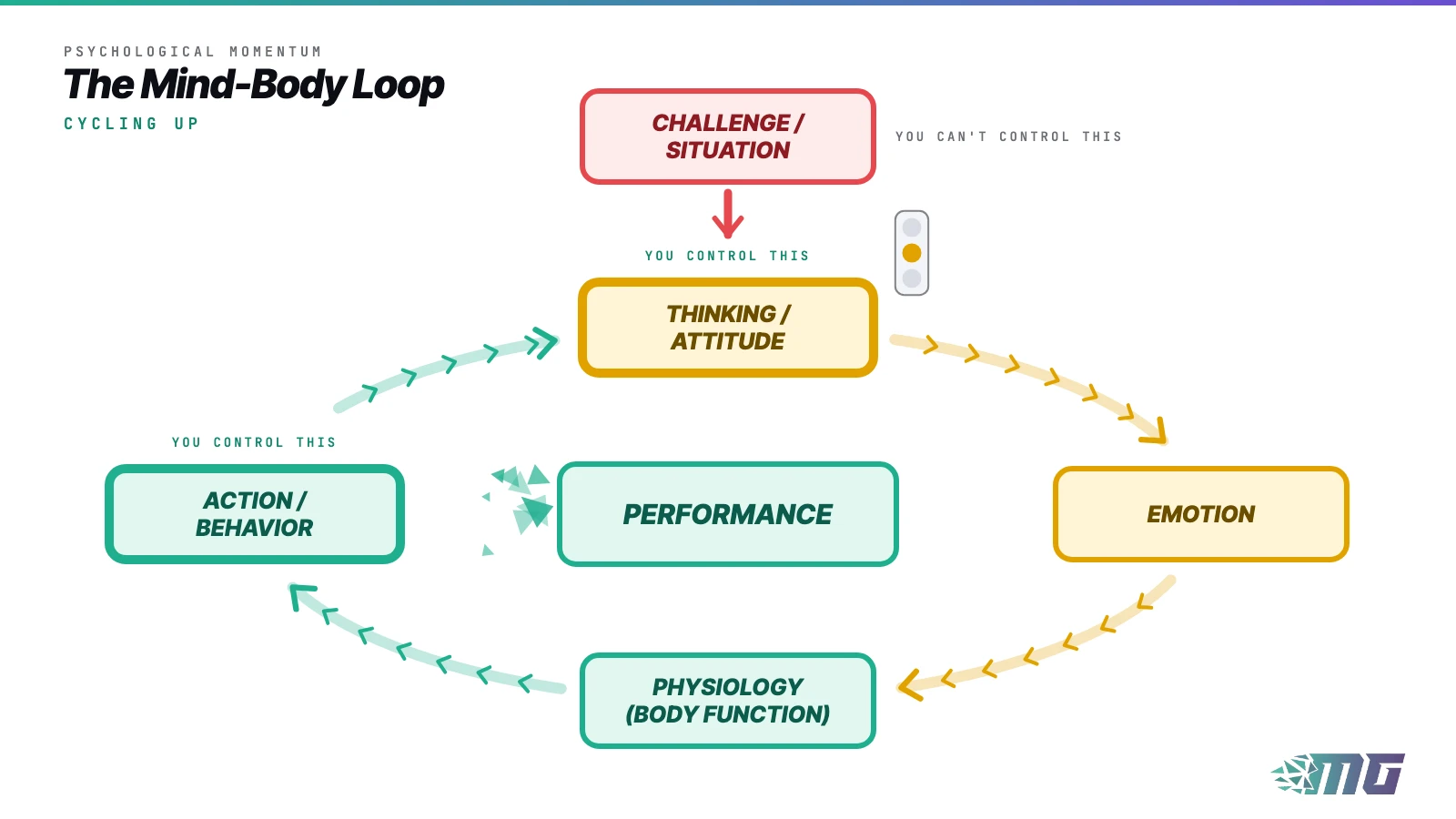
They are learning that they control two parts of it, actions and thinking, and that nerves are their body getting ready to race, not proof that something is wrong. And they are learning one tool for each: get big, and go neutral.
Here is why this matters to you: three of the six stages are things you can see. You cannot see a thought. But you can see what it does to the body, and what the body does to the stroke.
When a swimmer's thinking goes negative and stays there, the loop spins down: worry speeds up the breathing and tightens the muscles, the stroke shortens, the set gets harder, and the swimmer has fresh evidence for the thought that started it. Your swimmers know this as the doom loop. On deck it looks like a set coming apart one rep at a time.
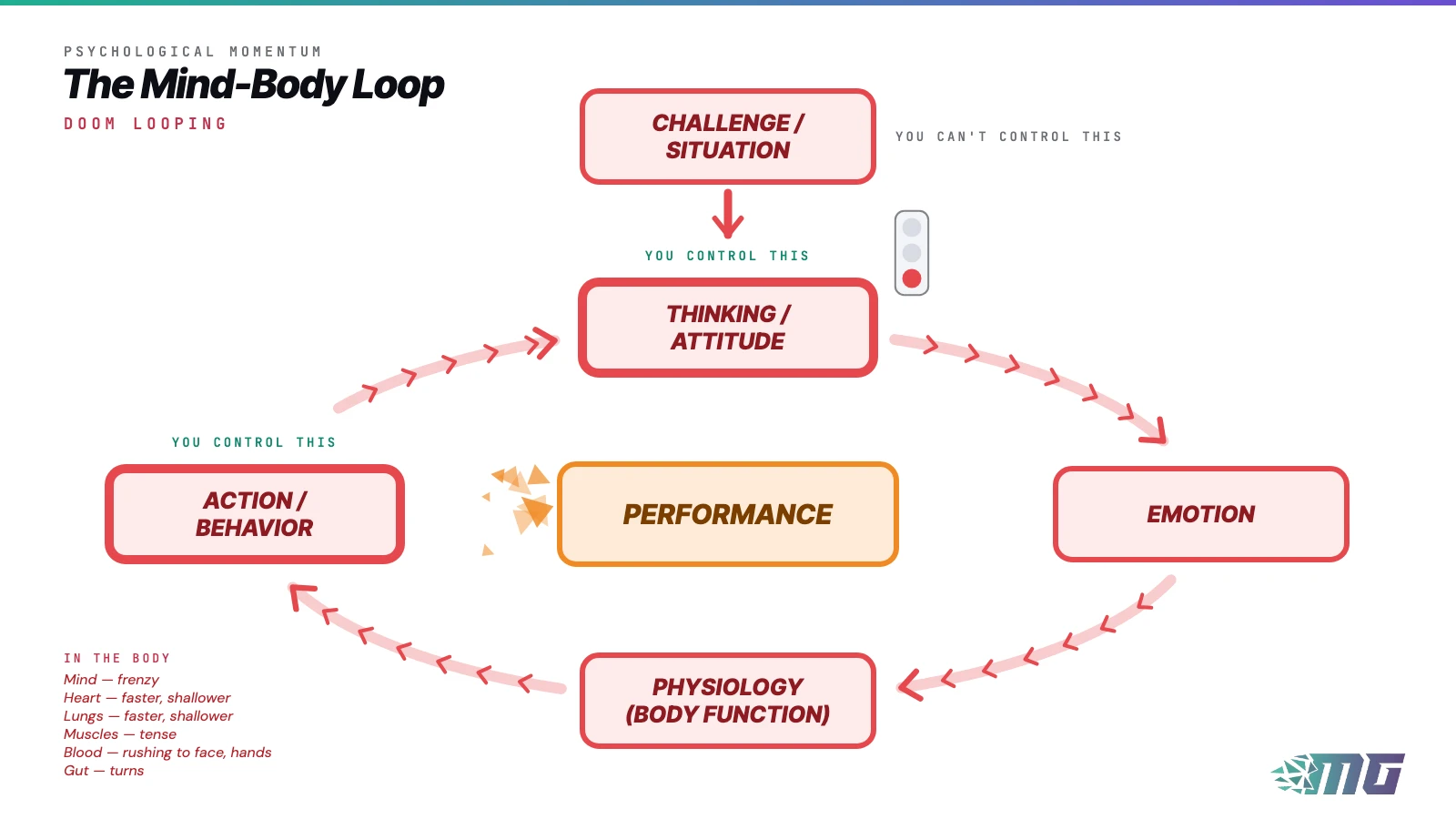
Walk the loop stage by stage and it tells you where coaching lands.
That last point is worth sitting with. Most of a coaching day is spent on the bottom of the loop: the time, and the stroke that produced it. The loop says the stroke you are correcting may be downstream of a thought you never heard. When a technical fix will not stick on one particular day, it is worth asking where in the loop the problem actually starts.
Left alone, the loop feeds itself. Each lap round reinforces the last, like a snowball rolling downhill. The same thing works in the other direction: a swimmer who settles, holds their stroke and hits one good rep has fresh evidence that pulls the next lap up.
Two things follow for a coach.
The goal is not positive. It is neutral. You do not need a swimmer fired up and believing they are unbeatable. You need them out of the red. Plenty of championship swims have been raced in neutral. A swimmer does not have to be positive to swim their best. They just cannot be stuck in the negative.
Mental toughness is the reset, not the absence of red. The way your swimmers are learning it: mental toughness is recognizing you are in the red and doing something about it, over and over again, even when it is hard. Going from negative to neutral. So the swimmer who resets five times in one set is not being soft. That is exactly what tough looks like. Say so when you see it.
And the younger the swimmer, the faster their loop swings, in both directions. Every time they interrupt it successfully, the next interruption gets a little easier. That makes the hard sets in practice the best place to build the habit, long before a championship meet asks for it.
Body, between reps and behind the blocks:
Thinking, showing up in what they do:
Actions, in the water:
None of these is a diagnosis. Some swimmers fold their arms on the bench however they feel. That is why the most useful thing you can learn is each athlete's normal, so you can see when they leave it.
Your swimmers have two levers. Your cue can hand them one, in the same words they are learning.
Get big, when you see them shrinking:
"Get big. Shoulders back, take up some space."
Your athletes are learning that when the body is big and taking up space, it is much harder to believe the negative stuff. A thirty-second reset on the wall or behind the blocks is a legitimate coaching intervention, not a soft one.
Go neutral, when you can tell their head has gone somewhere else:
Red thoughts live in what might be (I'm going to blow this) and what has been (I swam it badly last time). Your swimmers are learning to come back to what is: things that just are, not good, not bad, true right now. Ask a question that sends them there:
"What do you see right now?" "What can you hear?" "Tell me one thing you know for certain from this week's work."
The answer does not matter. "The lane line is blue" is a perfect answer. While they are looking for it, they are not in the red. Your swimmers also know this as the 5-4-3-2-1: 5 things they see, 4 they hear, 3 they feel, 2 they know for certain, and 1 slow breath to land on, which is the step that matters most. If there is a minute before the blocks, "Run your 5-4-3-2-1" is the whole cue. Listen for fresh answers rather than the same list every time. A swimmer reciting is not yet present.
One lever at a time, and keep it something they can do.
"Relax." "Calm down." "Stop being nervous." These ask the swimmer to switch off a feeling on command, which is not how feelings work. A swimmer who tries and fails can end up more activated than before, and now with a reason to think something is wrong with them.
Point them at a lever instead. Calm down is a result. Get big is something they can do. So is what do you see right now?
One more thing, and it is a reach for the coach as much as the athlete. Swimmers read their coaches. A coach pacing behind the blocks, arms folded, jaw tight before a big swim, is part of the challenge that starts an athlete's loop.
You do not have to fake calm. But your body is on deck too, and the same two levers work on you.
Reading the Loop on Deck is a 5x7 card for your clipboard. One side is the look-fors, body and stroke. The other is the cues for the two levers, get big and go neutral, and the three lines to leave out. Keep it where you can see it at your next meet.
Nerves aren't a verdict, they're your body getting ready to race. Two things you can do behind the blocks: get big, and come back to right now.
Read it so your language on deck matches what they are being taught.
Two a year for your club, one each season, virtual, for your 13-and-over groups. You pick the timing. Every booking is a request: we confirm it with you and sort out topics by email.

Nate is Utah Swimming’s Official Mental Performance Partner. He works with age-group and elite athletes on the part of the sport nobody schedules — confidence, composure, focus, and what happens in your head behind the blocks. Everything here is free to Utah Swimming families and coaches.


One mental-performance tool for athletes, parents, and coaches — every month in the Utah Swimming newsletter.
Mental Grit provides mental performance training, not mental health care. When a need is clinical, we connect families with licensed professionals.
Mental Grit Consulting is an independent organization and the official mental performance partner of Utah Swimming.