Don't, not and stop never make it into the picture. Why a don't sends the body toward the very thing you're trying to prevent, what avoidance does to how athletes feel and swim, and how to flip it.
Before you read another line, try something.
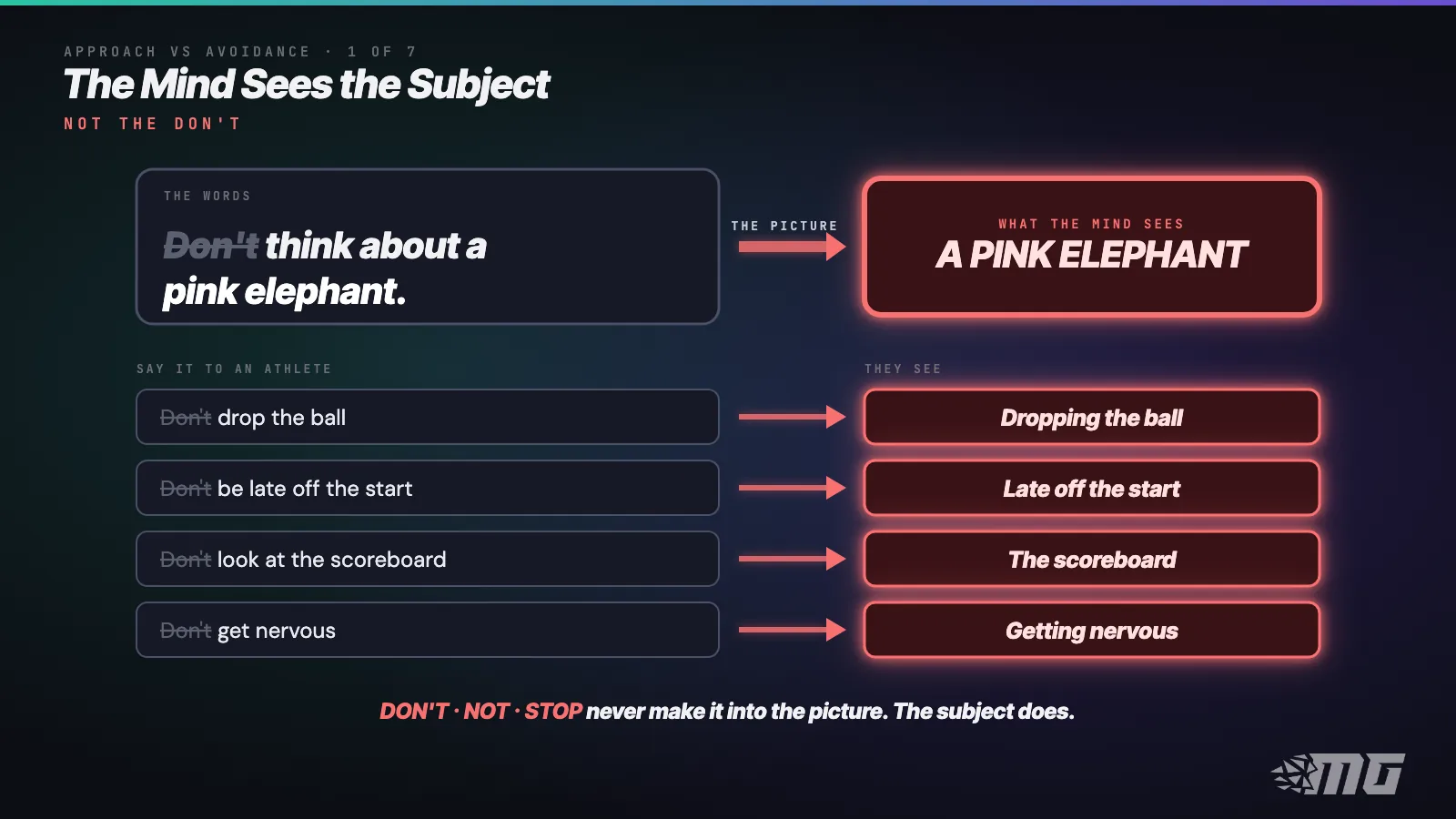
Don't think about a pink elephant.
You saw it. Pink, probably large, possibly flapping its ears. You saw it because I told you not to, and that one sentence is the whole of this month's article, from the athlete's side of your deck.
Here is the fact everything else rests on: as humans, we see the subject of what is being said, not the don'ts, nots and stops around it. Those words do not make a picture. The subject does.
So when a swimmer hears don't miss the wall, the picture that forms is the wall, missed. Don't breathe off the wall produces a breath off the wall. Don't go out too fast produces going out too fast. The "don't" is a grammar word. The picture is the instruction.
And that picture gets made in the athlete's mind every time, whether we meant to put it there or not.
This is the part that turns a language quirk into a performance problem.
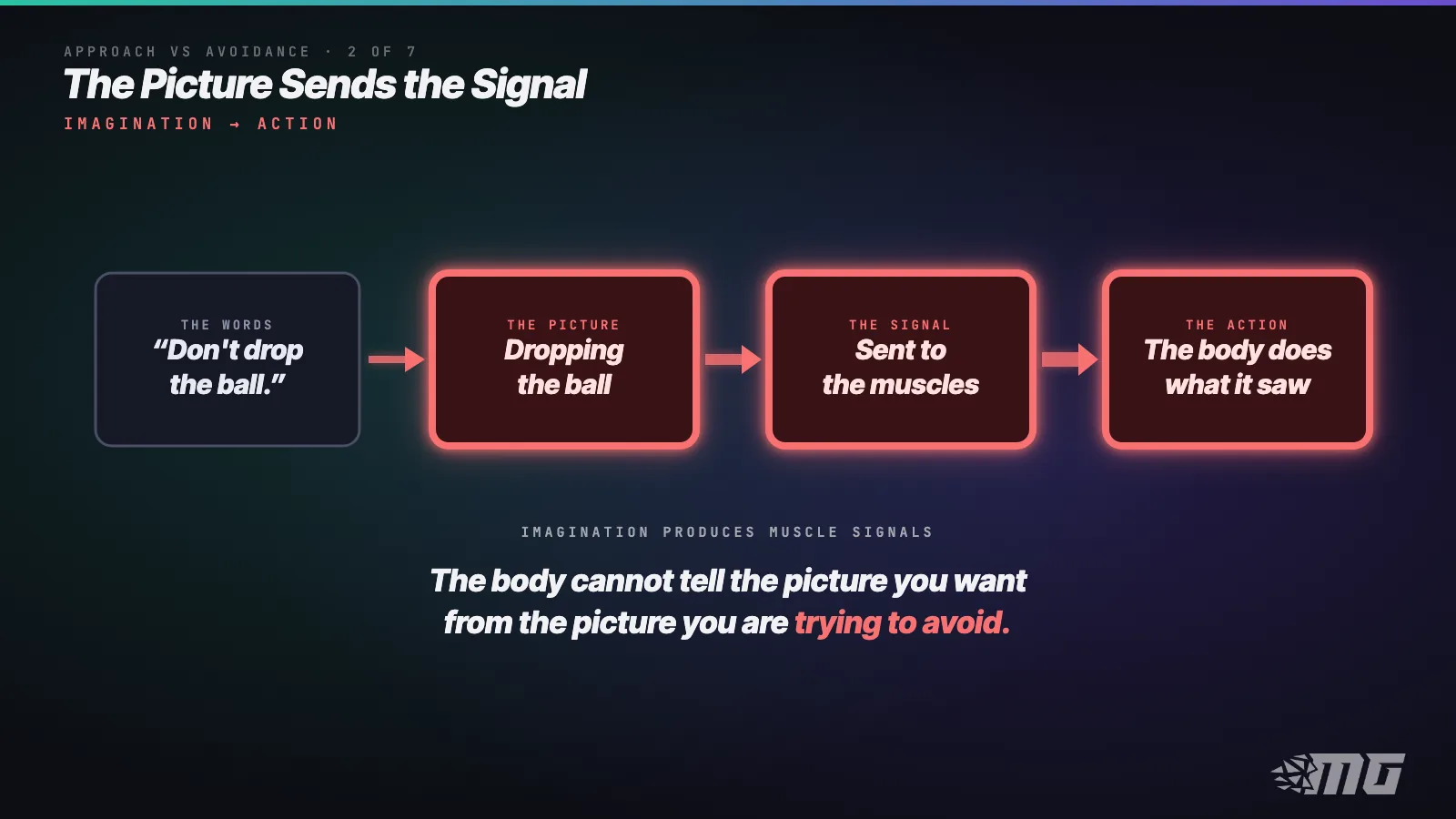
The picture an athlete creates in their mind sends a signal to their body to do what it sees. Imagining a movement fires the same signals the movement uses. The body does not check whether the picture was something we wanted or something we were trying to avoid. It just sees it, and starts to move toward it.
So a swimmer told don't drop your elbow has just seen a dropped elbow, and her body has been handed the signal for one, a few seconds before she has to swim.
Now run that forward over a season.
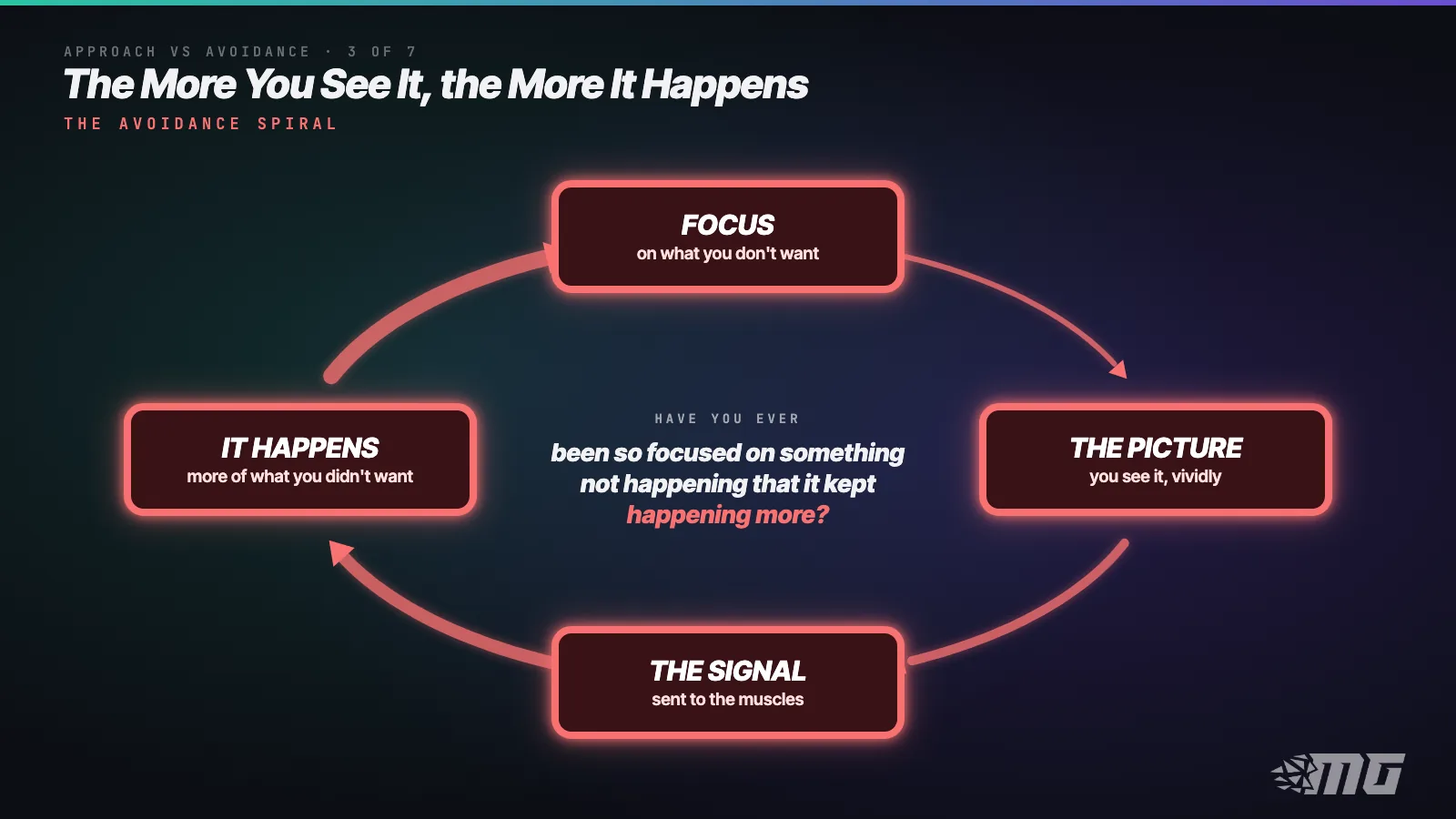
The more an athlete focuses on what they don't want, the more they see it in their imagination. The more they see it, the more signals go to the muscles to do it. And the more signals go, the more the thing they don't want actually happens, which gives them even more reason to focus on it.
Ask yourself this: have you ever been so focused on something not happening that it started happening more and more? The turn you kept telling yourself not to blow. The swimmer who has been told every week for a month not to breathe off the wall, and now does it on every wall.
That is not bad luck, and it is not a swimmer who is not listening. That is this concept, playing out exactly as it works. Researchers have watched it happen in the lab: golfers told not to hit the putt past the hole were more likely to overshoot it, and more so when they were under load. Pressure is load.
Here is what makes this urgent on a teenage deck.
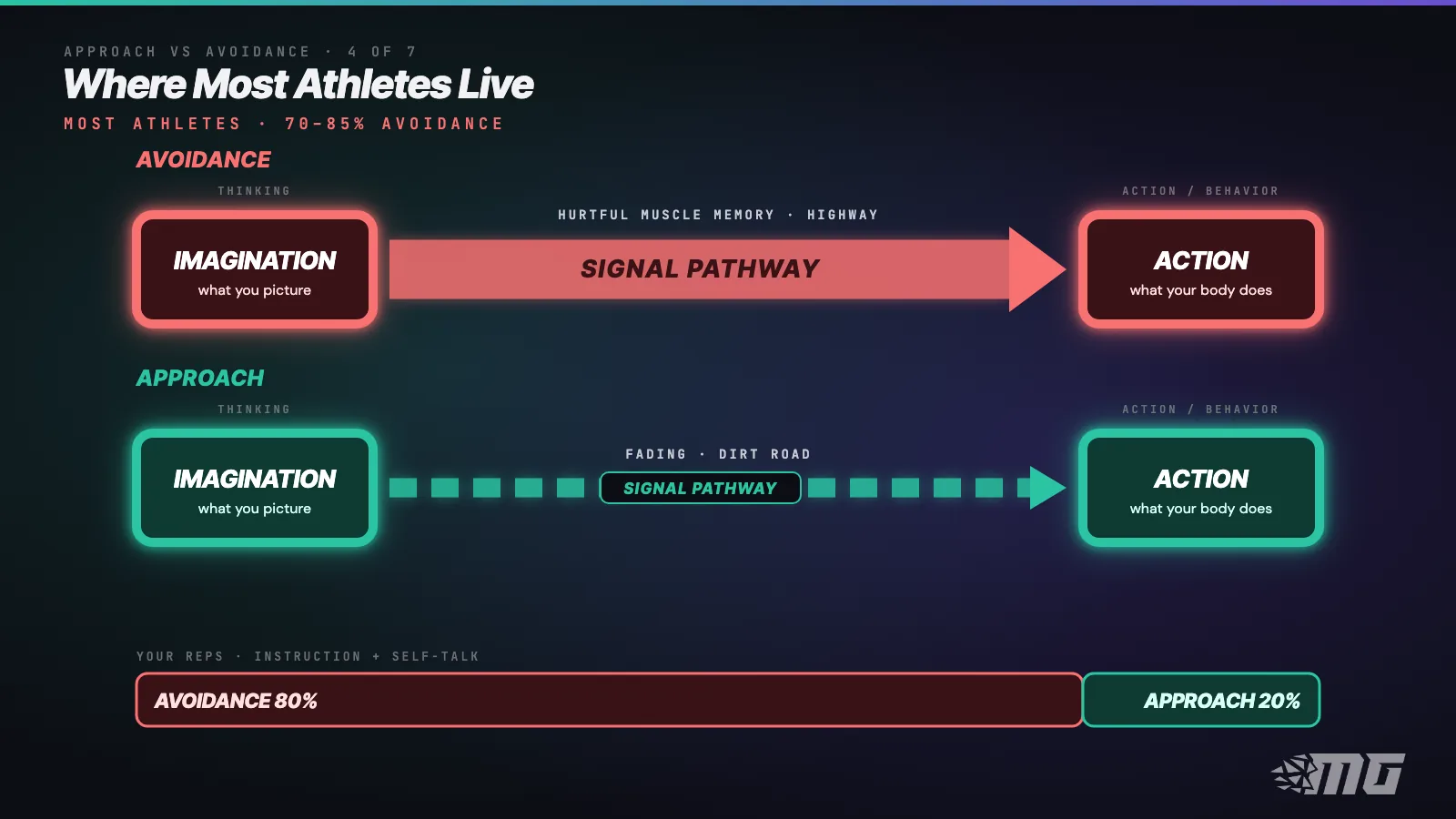
More often than not, teenage athletes are hyper-focused on the don'ts, nots and stops, and have very little idea of the do's behind them. Ask a fifteen-year-old what her goals are, or what she is looking to do in her next race, and you will often hear a list of don'ts: don't die in the last 50, don't breathe on the breakout, don't add time. Ask her what she wants to do instead and there is frequently a long pause.
That is not a character flaw. It is the language she hears and repeats, rep after rep, until avoidance is the road her signals travel by default. Every instruction and every line of self-talk is a rep on one road or the other, and a pathway grows with use.
The picture does not only steer the body. It sets the emotion the athlete competes in.
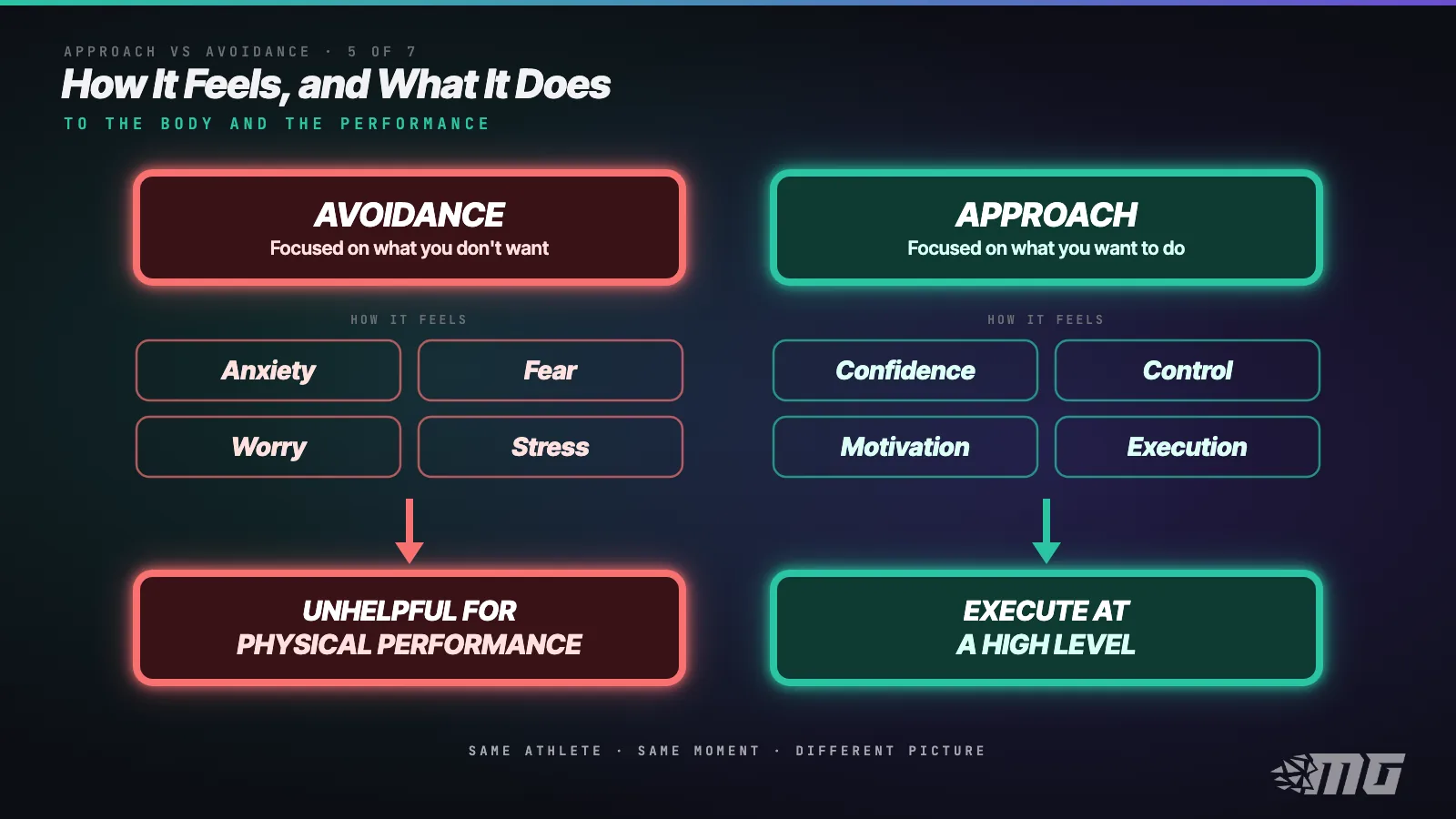
When an athlete is focused on avoidance, that is where you get anxiety, fear, worry and stress: the emotions that are least helpful for physical performance. You see it in the stroke. It gets short, tight and hesitant, because the body is busy steering away from something.
When an athlete is focused on approach, on what they want to do, it brings confidence, control, motivation and execution. That is the state that lets an athlete execute at a high level.
Same athlete. Same moment. Different picture.
Every don't has a do behind it. The work is finding it, and there is a trap halfway.
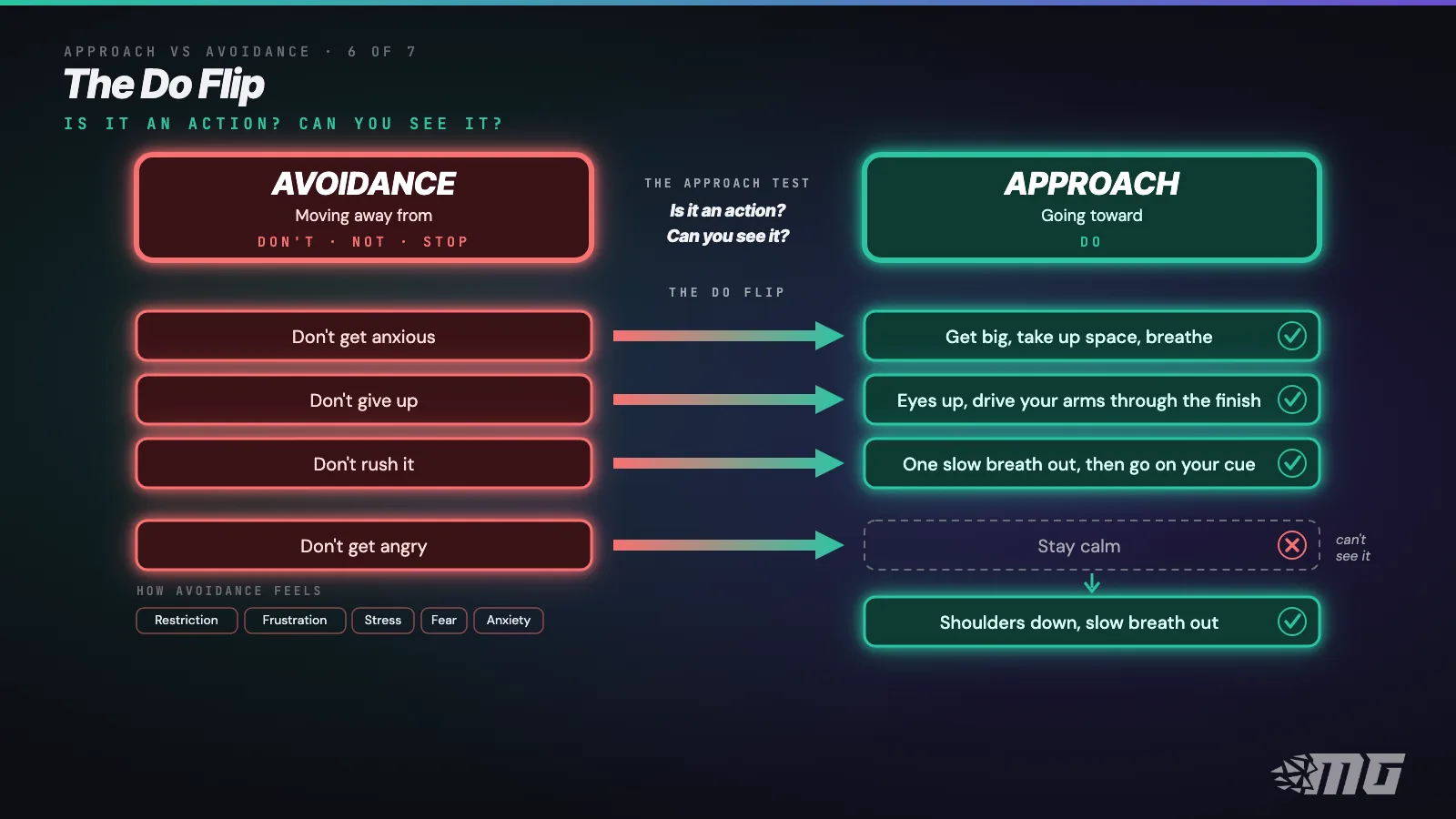
Don't die on the back half → finish strong is not a flip yet. "Finish strong" is an outcome wearing a do's clothes. She cannot see herself doing it, so it sends no clear signal.
A real flip passes two tests: it is an action, and she can see it.
Each line runs the don't → the outcome in disguise → the capability:
Your swimmers are learning this tool too, and they have a line for it: "I know what you don't want me to do. What do you want me to do?" If one of them says it to you, that is not backtalk. That is the tool working. Answer it.
So here is where it lands for us as coaches.
It is our job to help our athletes develop two things: the ability to see what they want to do, and the ability to execute on it, rather than staying hung up in avoidance.
Seeing it comes first. When an athlete hands you a don't, do not argue with it and do not rewrite it for them. Ask: "Okay. What do you want to do?" Then keep asking until the answer is something she could see on video.
Executing it is reps. Every approach instruction you give and every do she says to herself is a rep on the other road. Enough of them, and approach becomes the highway.
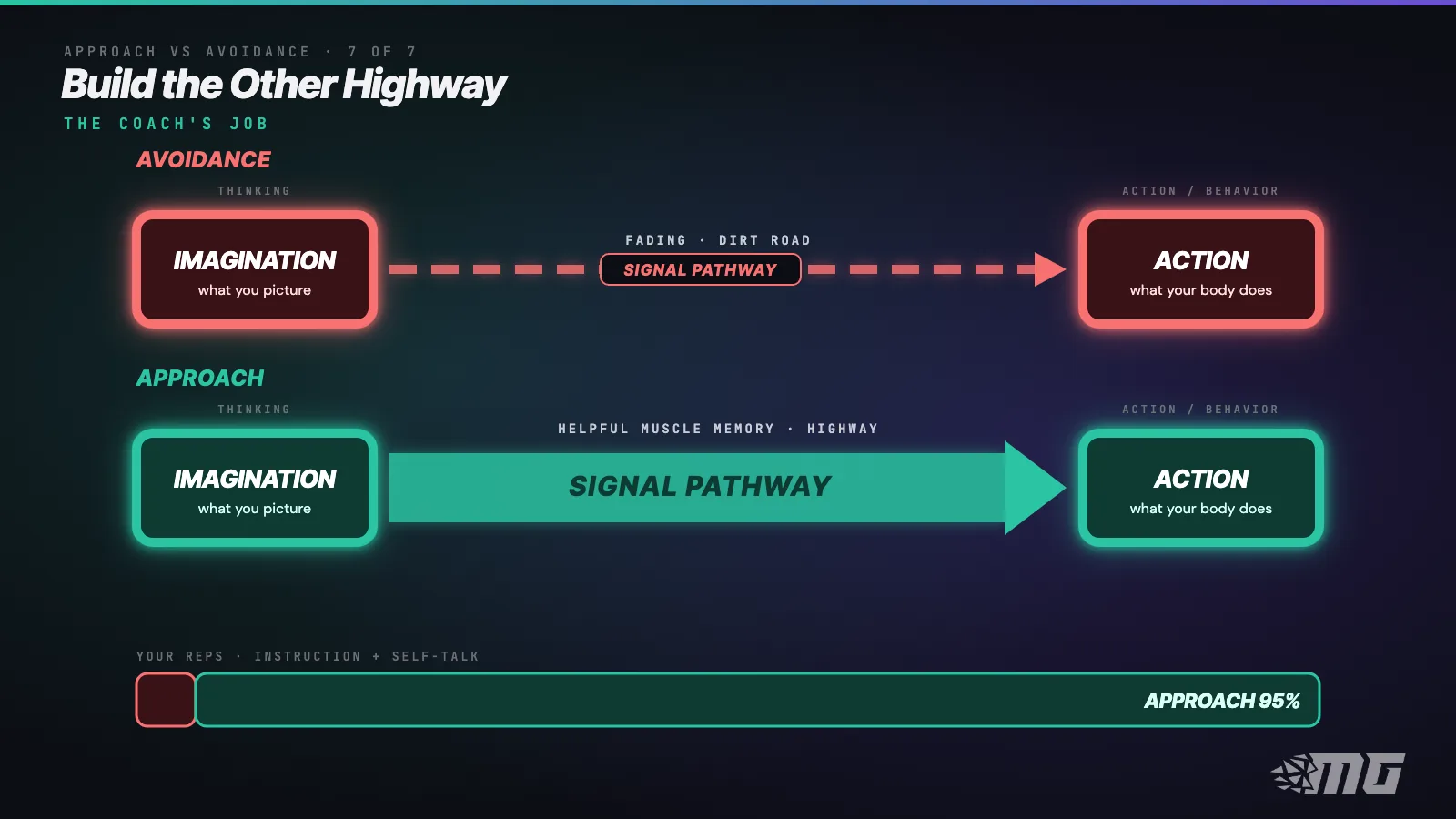
None of this needs a new session. It is the instruction you already give, pointed the other way.
Your swimmers will swim what they picture. You get to help decide what that is.
Don't, not and stop never make it into the picture. Why telling yourself what not to do makes it happen more, what it does to how you feel in the water, and how to flip it.
Read it so your language on deck matches what they are being taught.
Two a year for your club, one each season, virtual, for your 13-and-over groups. You pick the timing. Every booking is a request: we confirm it with you and sort out topics by email.
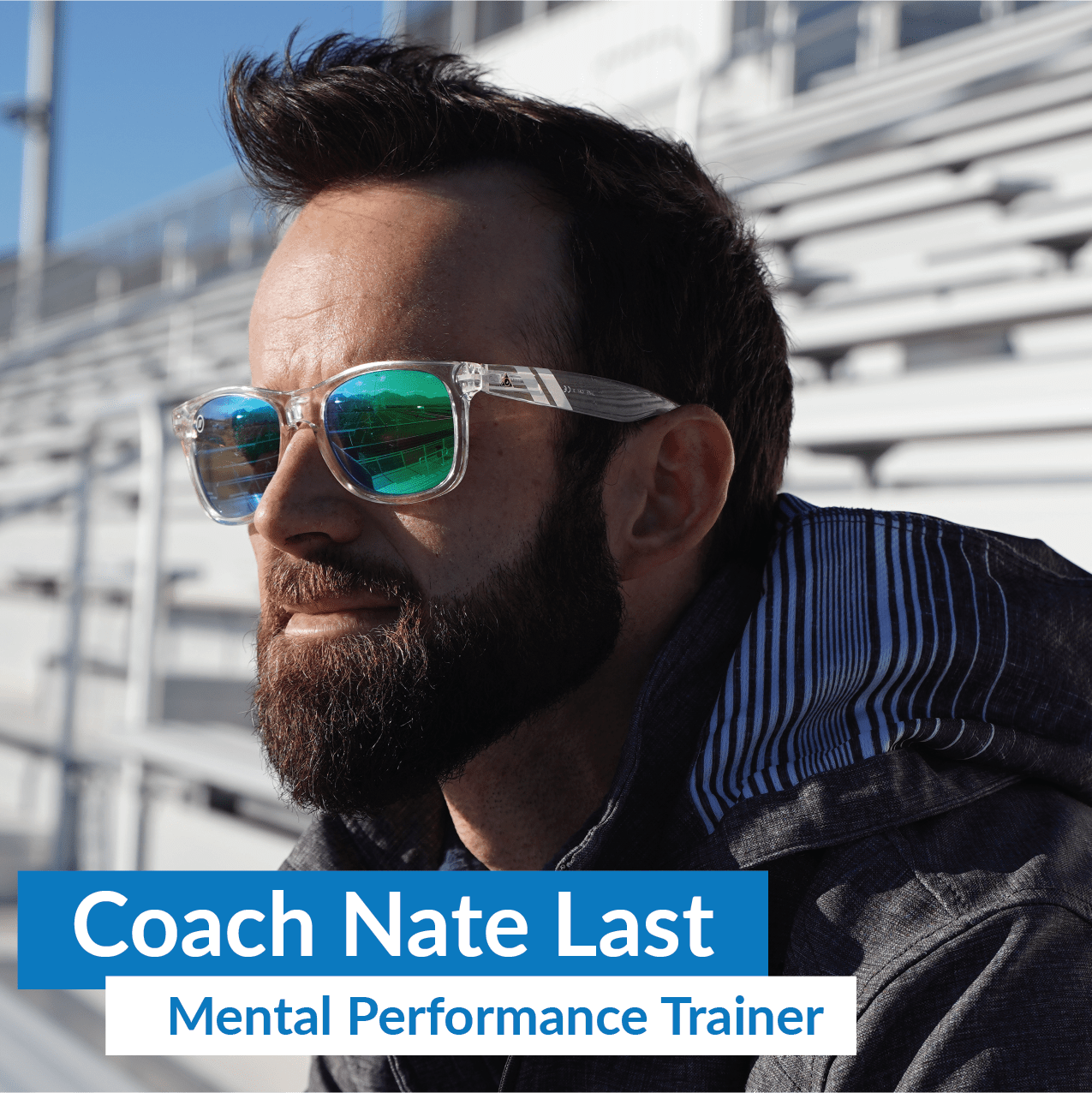
Nate is Utah Swimming’s Official Mental Performance Partner. He works with age-group and elite athletes on the part of the sport nobody schedules — confidence, composure, focus, and what happens in your head behind the blocks. Everything here is free to Utah Swimming families and coaches.

One mental-performance tool for athletes, parents, and coaches — every month in the Utah Swimming newsletter.
Mental Grit provides mental performance training, not mental health care. When a need is clinical, we connect families with licensed professionals.
Mental Grit Consulting is an independent organization and the official mental performance partner of Utah Swimming.